Parent’s Guide
7 Proven Benefits of Piano Lessons for Children
Parents invest in piano lessons for many reasons. Some want their child to develop discipline. Others want a creative outlet. Most discover that piano delivers benefits they did not expect.
Piano lessons do more than teach a child to play songs. They build cognitive skills, emotional maturity, physical coordination, and personal discipline in ways that compound over years of study. Here are seven benefits backed by research and confirmed by 16 years of teaching experience with 60+ students at Lively Keys Piano Academy in Sarasota, FL.
Discipline and delayed gratification
Learning piano teaches children that progress requires sustained effort over weeks and months. A child cannot learn a recital piece in one sitting — they must practice daily, work through frustration, and trust that small improvements compound. This transfers directly to academics, sports, and any skill that rewards persistence over quick results.
Stronger academic performance
Multiple studies have linked music education to improved math skills, reading comprehension, and spatial reasoning. Piano specifically engages pattern recognition (reading music), counting (rhythm and time signatures), and sequential logic (following a score from beginning to end). Students who study piano often outperform non-musical peers on standardized tests — not because piano makes them smarter, but because the cognitive skills transfer.
Fine motor development and coordination
Playing piano requires independent movement of all ten fingers, hand-eye coordination between the score and the keyboard, and bilateral coordination between left and right hands doing different things simultaneously. For young children, this accelerates fine motor development. For older children, it refines precision and timing in ways that benefit handwriting, typing, sports, and other physical activities.
Emotional expression and regulation
Music gives children a vocabulary for emotions that words cannot always capture. A child who plays a sad piece learns to sit with that emotion rather than avoid it. A child who plays an energetic piece channels excitement into something structured and productive. Over time, students develop greater emotional awareness and healthier ways to process feelings — especially during adolescence.
Confidence through performance
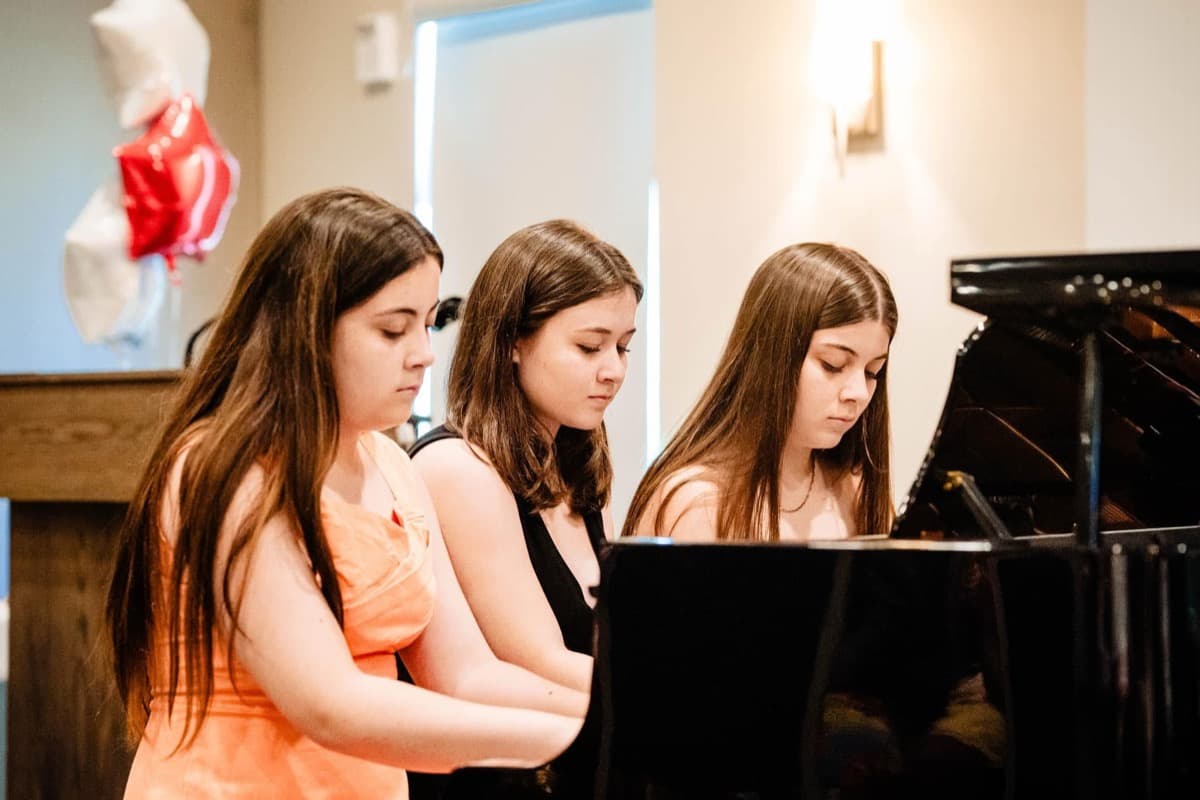
Performing at a recital — standing in front of an audience and playing a piece from memory — builds genuine confidence rooted in preparation and competence. This is not participation-trophy confidence. Students know they earned it because they practiced, prepared, and delivered. That experience carries into public speaking, presentations, interviews, and any situation where performing under pressure matters.
Goal-setting and self-direction
Piano students learn to set goals (learn this piece by recital), break them into steps (practice measures 1-8 this week), and track their own progress. With the Lively Keys practice app, this becomes concrete: students see their streak count, gem total, and leaderboard position. They learn what consistent effort looks like — and what happens when they skip days. These are life skills disguised as a music lesson.
A creative outlet that lasts a lifetime
Unlike many childhood activities that fade after high school, piano is a skill that stays. A child who learns piano at age 7 can still sit down and play at 17, 37, or 77. They will always have access to an instrument that can calm them down, energize them, or simply give them something beautiful to do with their hands. That is a gift most extracurriculars cannot offer.
The key is consistency
These benefits do not appear after one lesson. They develop over months and years of consistent practice and instruction. That is why the Lively Keys practice app exists — to make daily practice something children choose to do rather than something parents have to force. When practice is consistent, every benefit on this list accelerates.
At Lively Keys, students earn gems for every minute practiced, unlock companion characters, complete daily missions, and compete on a studio leaderboard. The gamification is not a gimmick — it is a system designed to build the consistency that makes piano lessons worthwhile. Lessons start at $175/month and include full app access.
Ready to give your child these benefits?
Lively Keys offers private piano lessons for ages 5 through 17 in Sarasota, FL and via video. Reach out to schedule an introductory lesson.